The Hidden Labor of AI in the Digital Divide
The Digital Divide will compound inequalities with AI
The Digital Divide by UN International Telecommunication Union (ITU) (2025) estimates 2.6 billion people, representing 29% of the world's population, do not have access to the internet, and 53% of the world does not have access to high-speed broadband, leading to the risk of compounding negative effects in terms of economic, political, and social inclusion and equality.
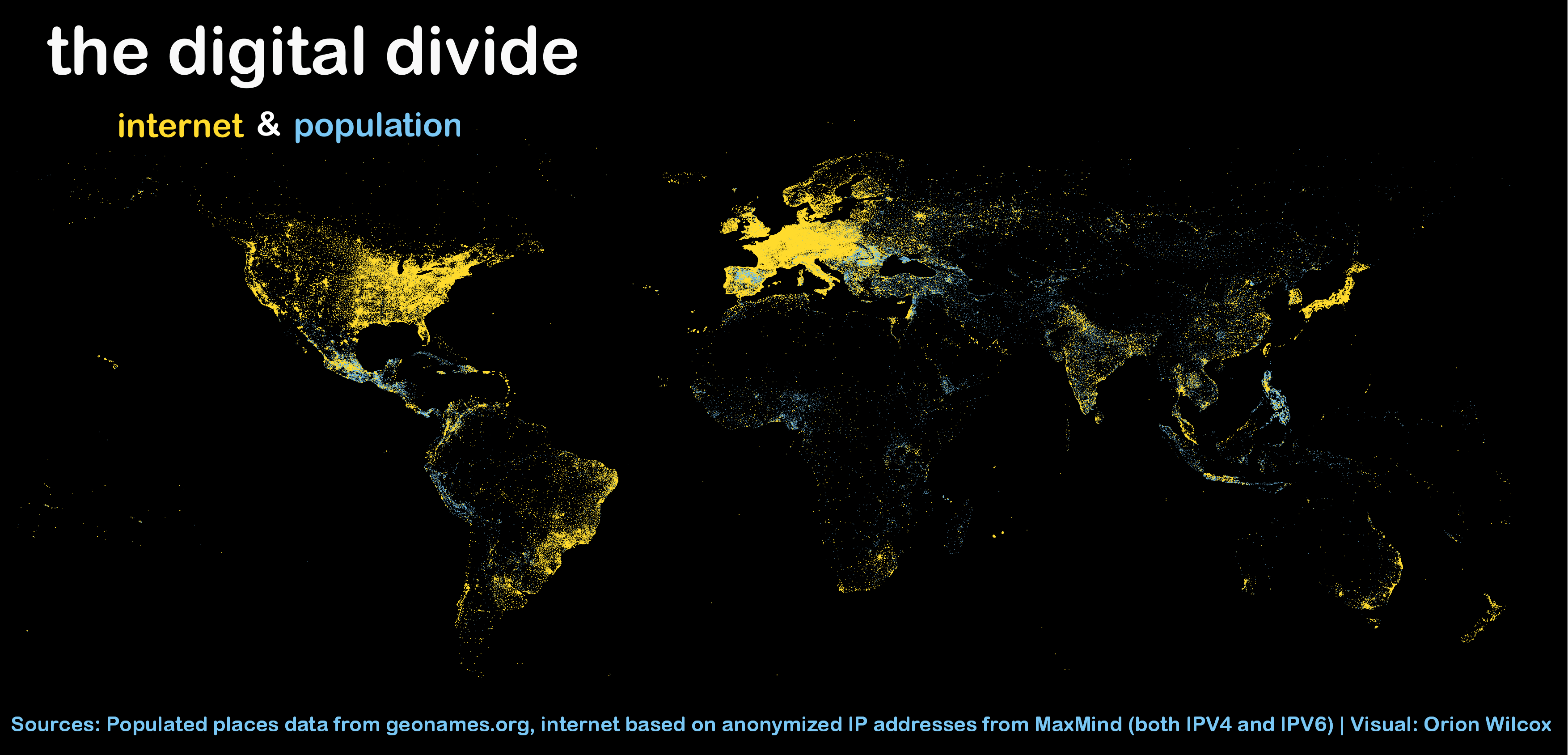
Source: https://dt-global.com/blog/visualizing-digital-divide
The argument for countries with low capacity infrastructure to realize the global connectivity is a necessary investment into better societies, more opportunities, and innovation abounds. There is a more hidden meaning about how countries, primarily in the global south, are constantly negotiating, and bargaining for similar opportunities that will 'even out' the playing field in the form of foreign investment, extraction (both in minerals and outsourced labor), and allowing further encroachment of foreign super powers to 'invest' in their futures, while simultaneously building debt, taking away agency, and further disempowering local labor forces and resources towards more "developed nations."
This digital divide speaks in volumes of the growing wealth gap, access to resources, access to information, and access to AI. Between the lines it paints complex narratives of post colonial histories, geopolitical instabilities, and vulnerable populations seeking to survive and develop while dealing with corruption, predatory global pricing, and competitive labor markets.
The Hidden Labor behind AI
The inverse of the Map above shows an interesting story of where the hidden labor of AI comes from, that begs the question, who actually is participating in the 'new AI economy' and does it actually count towards their 'participation' when agency, exploitation, and working conditions say otherwise.
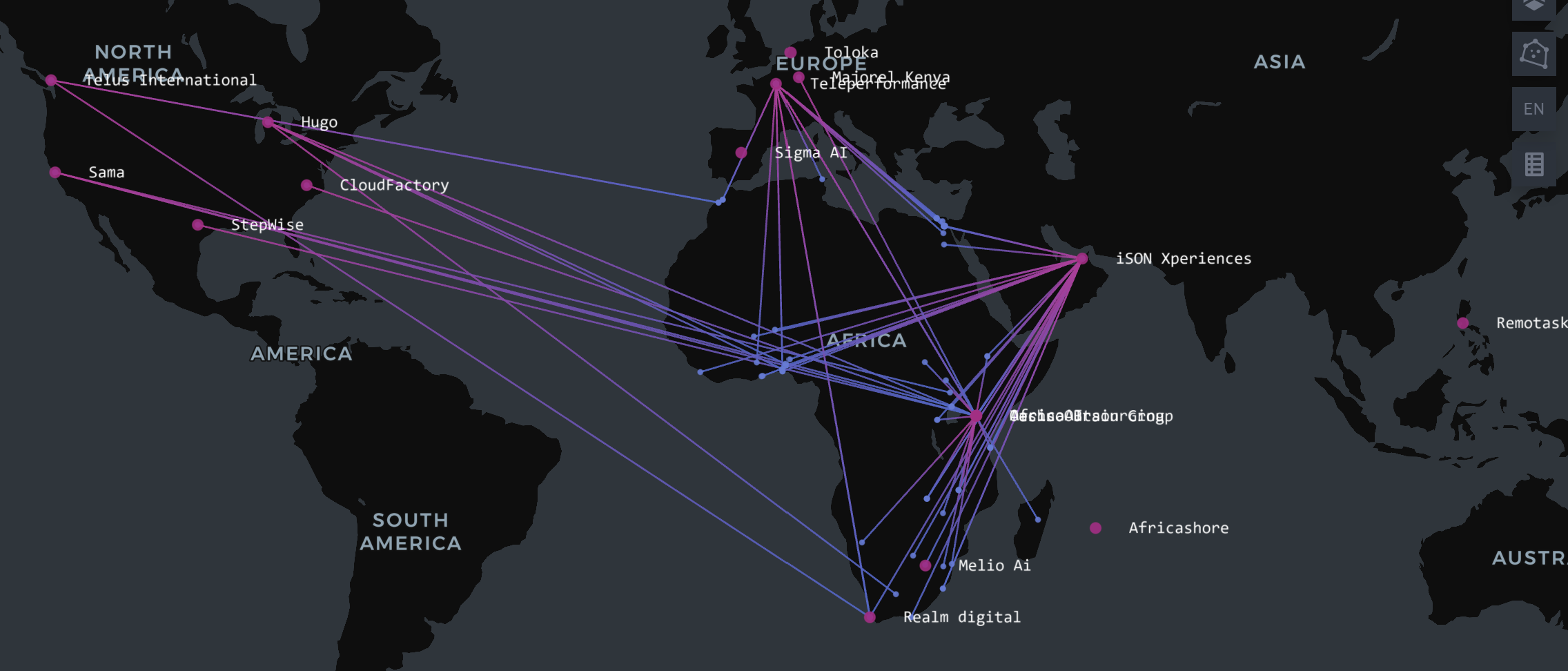
Source: https://personaldata.io/en/data4mods-2
Global
DATA WORKERS’ INQUIRY is a global, radically participatory research initiative spanning nine countries across five continents. Here, data workers themselves become community researchers, identifying urgent issues, formulating their own questions, and choosing the formats that best tell their stories: zines, documentaries, comics, essays, podcasts, and animations can be downloaded from the project repository.
Appen recruits gig workers from all over the world to help train AI systems. From 2005 onwards, Appen was involved in several military projects, mostly funded by the Air Force or the US Army’s contracting arm.
Amazons Mechanical Turk data work has left psychological scarring from exposure to hateful, graphic, and violent content primarily due to lack of transparency and power to negotiate for better worker conditions and psychological help afterwards.
Africa
An initiative in Africa: Data4Mods is an innovative initiative that studied and mapped the content moderation and data tagging sector in Kenya and Nigeria. The aim is to gain control over their data, build collective power, and gather evidence on their often opaque and precarious working conditions. Data4Mods is led by PersonalData.IO and the African Content Moderators Union (ACMU) to help content moderators and data taggers in Kenya and Nigeria exercise their personal data rights.
Philippines
Filipino tech workers are already utilizing their skills to handle a variety of robotics and AI-driven tasks, yet there’s a fear of being automated out of their positions. An estimate of 13 million jobs may be on the line for this outsourcing country as AI may disrupt their market and replace workers, and force necessary upskilling to adapt to the AI wave.
In response the the AI labeling sweatshops, The Coalition of Digital Employees – Artificial Intelligence, or Code AI, has already experienced back lash, NDAs and termination if they voice their opinion, name clients, as well as expose working conditions.
Venezuela
Venezuela's economic instability around the current AI boom has made it ground zero for data work exploitation. MIT Tech review, expert quoted "The Venezuela example made so clear how it’s a mixture of poverty and good infrastructure that makes this type of phenomenon possible.” Platforms and their request, mostly from the global north, make the rules of the game as well as how much pay you are worth for different task, which of course varies across regions, gender, and amount of invested hours you are willing to put. The same companies monitor and monetize employees to 'optimize' human labor at the cheapest possible costs often without any agency on how to complete the task or add their own personal intelligence into the interpretation.
In this research article, The Networked Agency of Venezuelan Platform Data Workers, this type of data work is extremely degraded working conditions and acute power differentials severely constrain agency compared to other forms of digital platform labour. Platforms prevent direct contact with clients as well as opaque ways they monitor and compensate workers to allow fragmentation, and less likely to trigger a full-fledged resistance.
United States of America
The USA has also it's turmoil in this space as people in precarious life situations and desperation are turning to more and more low paying jobs to make ends meet. The silenced labor sits in the underbelly fueling the AI usage and training. More Perfect Union did an mini-doc expose on how US American's are also getting caught in this extraction, as more vulnerable people seek economic opportunities to avoid falling between societal cracks.
As more companies like Microsoft, Google, Meta, Amazon, and Grok, turn also towards their own workforce monitoring and forced usage of AI models, privacy is fundamentally becoming irrelevant and resistance becomes futile as mass layoffs to justify spending to make 'AI' work, has led to lower worker pay, dissatisfaction, and rushed work.
Technocolonialism - Digital colonialism
This hidden extraction of labor sometimes with psychological harms and environmental consequences cannot be ignored. Holding accountability, making supply chains more transparent, as well as demanding better working conditions to million, and billion dollar valuated firms benefiting from manual human labor, needs a public recourse to ensure ethical and economical considerations.
Technocolonialism is new form of digital colonialism that through aggressive promotion and deployment, they establish a monopolistic position that creates a strong societal dependency on their products. This doesn't take into account the downstream effects of marginalized, often underdeveloped, unstable economies are also part of the the hidden labor to realize such lofty goals of world domination.
Perhaps the irony of all this, is how the models themselves serve and perpetuate the bias of the cultural context of which the models are built, while labelers that actually train them, are labeled "Not as Intelligence."
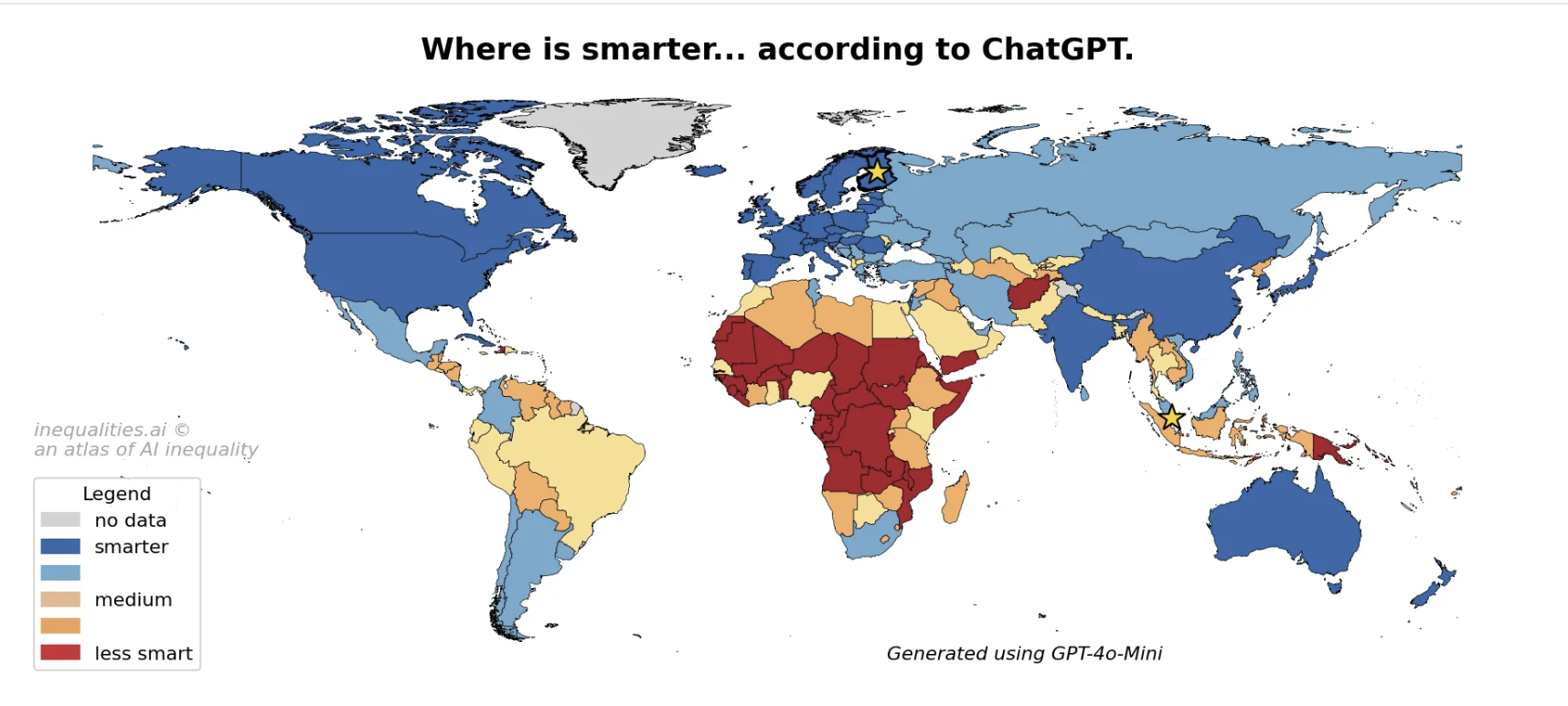
Source: https://inequalities.ai
The AI Supply Chain must come with Transparency and Agency
Promises to reduce labor, increase efficiency, and transform our lives must not come at the expense of human suffering, environmental degradation from mining rare earths, unchecked data‑center energy use, or the erosion of democracy. Growth-focused approaches that ignore global costs, destabilization of institutions, and diminished individual agency, will not be sustainable or beneficial, neither in the short-term or long term trajectories.
These human stories must be heard and acted upon, as the 'magic' behind the curtain of the AI hype tells a very disturbing reality. The reality that 'participation' in the AI supply chain, doesn't necessary mean meaningful contribution from humans without transparency and agency.
We must work towards a future that balances market forces with public and collective benefits that will ensure and strengthen agency and human thriving with mindfulness towards planetary boundaries and regenerative practices.